Switzerland, Germany to boost job skills in Laos
|
|
|
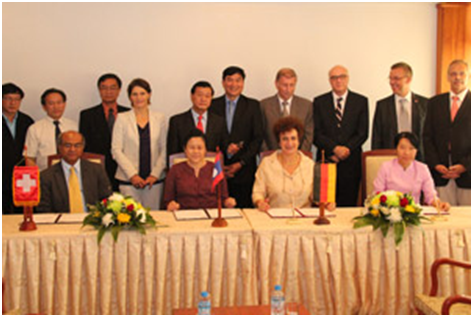
Switzerland and Germany will support the Lao government to strengthen the vocational education system and meet the changing needs of the labour market. A major goal of this support is to allow students from all walks of life to acquire skills, find employment, and earn higher incomes. The support marks the beginning of the trilateral collaboration between the Swiss Agency for Development and Cooperation (SDC), the Deutsche Gesellschaft fuer Internationale Zusammenarbeit (GIZ) GmbH, and the government of Laos to improve the trade skills of young people. An agreement to this effect was signed in Vientiane on Friday. Those signing the agreement included the Ministry of Education and Sports' Director General of the Department of External Relations, Ms Chantavone Phandamnong, and the Ministry of Planning and Investment's Deputy Director General of the Department of International Cooperation, Ms Sisomboun Ounavong. The signing ceremony was also attended by Deputy Minister of Education and Sports Professor Dr Kongsy Sengmany, Country Director GIZ Laos Dr Petra Mutlu, Head of the East Asia Division SDC in Bern Mr Pradeep Itty, Director of SDC Mekong Region Ms Ruth Huber, and other officials involved. Speaking on the occasion, the Director of GIZ's Human Resources Development for Market Economy programme, Mr Armin Hofmann, said “As the Lao economy's eight percent annual growth rate is mainly based on the natural resources-based sector, the government has identified a need for market diversification and the expansion of other sectors such as agri-business and tourism.” “The diversification of the Lao economy therefore requires advanced skills and further expertise among Laos' young people in particular.” The new programme aims to make the technical and vocational education and training system more practice-oriented and appropriate to employers' changing requirements. “People who need new skills most to work themselves out of poverty today are widely excluded from technical vocational education training. I am proud that the programme will apply affirmative action to allow more girls and more young people from ethnic communities to get skills training,” Mr Itty said. The reform of the vocational education system will allow more students from disadvantaged backgrounds, especially girls from rural areas and children from various ethnic groups, to attend school and to acquire vocational skills. While the reform process of laws, competency frameworks and curricula will be initiated in Vientiane, the programme's practical implementation such as the management of Integrated Vocational Education Training schools will take place in the 10 most remote provinces of Phongsaly, Luang Namtha, Oudomxay, Xieng Khuang, Xayaboury, Huaphan, Saravan, Xekong, Attapeu and Borikhamxay. About 30,000 students enroll in technical and vocational schools in Laos every year – with a clear tendency towards high enrolment due to the growing demands of the labour market. Latest Updated February 11, 2013 |
|